I don’t actually know my exact age anymore. If I had to guess, I’d say somewhere in my fifties. Maybe early sixties. It’s strange how something as simple as a number can slip away from a person, as if time itself stopped caring enough to keep track.
People used to ask me that question like it was supposed to be easy. “How old are you?” they’d say, casually, like the answer was stitched into my clothes or printed on some forgotten document in my pocket. I never had a proper reply. I would usually give a tired smile, rub the back of my neck, and say something like, “Old enough to feel it in my bones.”
They would laugh, thinking I was joking. Most of them didn’t realize I wasn’t trying to be funny.
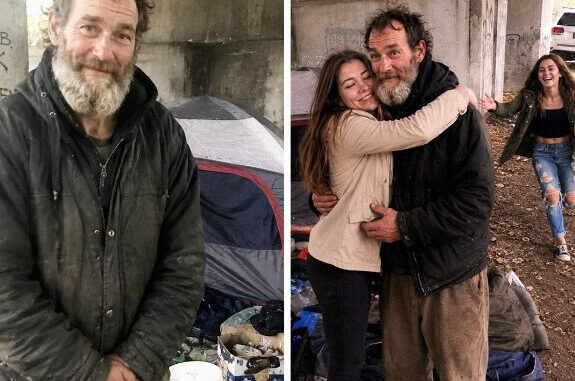
Thirteen years ago, I woke up under a bridge with no memory of who I was.
Not a blurry memory. Not fragments. Nothing at all.
There was only cold concrete beneath me, the distant roar of traffic above, and a heavy ache in my head that made it difficult to even sit up. The air smelled like wet pavement, rusted metal, and damp garbage that had been sitting too long in the rain. My body felt like it didn’t belong to me.
When I finally forced myself to look down, I noticed stains on my jacket. Dark, dried patches that looked disturbingly like blood. That realization alone was enough to make my stomach tighten.
For several minutes I just sat there, waiting for something inside me to recognize itself. A name, a place, anything. But nothing came. It was as if my entire past had been erased clean.
Around me, other men were already awake or still sleeping—people wrapped in torn blankets, cardboard, and worn-out coats. A man with a long gray beard sat nearby, sorting through plastic bags in a shopping cart. Another was sipping something from a paper cup, staring into space like he was waiting for a world that never arrived.
I finally spoke to them, my voice rough and uncertain.
“Do you know me?” I asked. “Do you know what happened to me?”
The man with the cup looked at me for a moment, squinting as if trying to place my face. Then he laughed—not cruelly, but in a tired way, like he’d heard too many broken stories to take another seriously.
“Man,” he said, shaking his head, “you’ve been around here for years. Quit acting like you don’t know.”
His words confused me even more.
I insisted again, asking questions I had no answers to. My name, my life, whether anyone had been looking for me. One man suggested I might have answered to “Fred” once or twice. Another said I mostly kept to myself. Someone else guessed I had probably drunk too much and lost my memory that way.
But I didn’t feel intoxicated. I didn’t feel anything except empty.
Days became weeks. Weeks became months. And still, nothing returned.
No name. No family. No past waiting to catch up with me.
Eventually, I learned to survive in that emptiness.
Life under bridges and behind buildings teaches you things you never expect to learn. I watched people pass by every day—parents holding children’s hands, office workers rushing across streets, friends laughing as they went somewhere I would never be invited.
Sometimes I would catch myself staring too long at strangers, wondering if one of them might suddenly stop and recognize me. A woman might look at me and gasp, saying I had been found at last. A man might call my name and pull me back into a life I couldn’t remember.
It never happened.
Over time, hope started to feel heavier than hunger. I stopped carrying it around.
That doesn’t mean I stopped caring. It just means I stopped expecting anything to change.
Still, I refused to simply beg for survival. I couldn’t bring myself to sit in one place holding out my hand for coins. Instead, I worked wherever I could.
I cleaned parking lots before sunrise, dragging heavy garbage bags that strained my shoulders. I helped unload boxes in warehouses for cash payments that never came with questions. I painted fences in quiet neighborhoods while dogs barked behind closed gates. Sometimes elderly couples would watch me from their windows and later leave me sandwiches wrapped in napkins.
Some days I ate well. Other days I ate nothing at all.
There were nights when my stomach cramped so painfully that I had to curl up beneath the bridge and wait for morning just to distract myself from the ache. Winters were worse. I slept in every layer I owned, shivering until my body went numb. Summers brought heat, insects, and the constant smell of the river nearby.
I became invisible in a way I never wanted to understand.
And yet, I followed a simple set of rules just to keep myself steady: don’t steal, don’t harm, don’t drink yourself away, don’t lose your dignity even when the world stops seeing it.
Years passed like that.
Then, three days ago, something changed.
I was offered a short-term job helping renovate a small café. It was located on a corner street, modest and worn down, with a faded green awning and dusty windows that hadn’t been cleaned in years. The owner, a man named Niles, needed help repainting the interior before reopening.
He didn’t ask many questions about me, which I appreciated more than I could explain.
I worked through the day painting walls and trim. My arms ached by midday, and my clothes were stained with pale paint, but I kept going. Niles watched me occasionally, not in suspicion, but in a strange kind of focus—like he was trying to place something just out of reach in his memory.
People sometimes look at me like that. Like they almost recognize something in my face but can’t quite retrieve it.
By late afternoon, the café smelled of paint, dust, and old coffee. Niles kept wiping the counter even when it was already clean.
Before I left, he paused and asked, almost hesitantly, “Have we met before? You look familiar.”
I gave a small, awkward laugh. “If we did, I don’t remember it.”
Most people would have let the conversation drop after that. But he didn’t. He just stared at me a little longer than necessary, as if something about me was pressing on a memory he couldn’t fully access.
That night, I returned to my usual shelter beneath the bridge. My hands still carried faint traces of paint, and my thoughts refused to settle.
Something about his reaction stayed with me longer than it should have. But I told myself it meant nothing. People mistake faces all the time. They see resemblance where none exists.
Still, sleep didn’t come easily.
The next morning, I woke to the sound of an engine pulling in nearby.
That sound always put me on edge. Vehicles rarely came down there unless it meant trouble.
I sat up slowly, listening. Gravel shifted. A door opened.
Then I saw movement outside the tent.
Two young women—teenagers, maybe sixteen or seventeen—ran toward me. They looked identical, like twins. Same dark hair, same frantic energy, same expression of disbelief and urgency.
I froze, unsure of what I was seeing.
One of them lifted a hand to her mouth. The other was already crying before she even reached me.
They stopped just a few feet away, staring like they were afraid I would vanish if they blinked.
One of them whispered a single word.
“Dad?”
The impact of that word hit me harder than anything I had felt in years. My legs weakened instantly, and I had to grip the tent frame to stay upright.
The other girl shook her head, tears running down her face. “It’s really him.”
I couldn’t process it. My mind resisted every attempt at understanding.
Then another figure approached—a woman in her forties, trembling, her face pale with emotion. Behind her stood Niles.
“I’m sorry,” he said quietly. “I had to call them.”
The woman stepped closer, studying my face as though afraid I might disappear if she looked away.
“Mark,” she whispered.
The name struck something deep inside me—something buried, locked, and painful.
I shook my head. “I don’t know what you’re talking about.”
One of the girls stepped forward. “I’m Mia.”
The other followed quickly. “I’m Sophie. We’re your daughters.”
The words didn’t make sense at first. They couldn’t. My mind rejected them, even as something inside me began to fracture.
Then images—faint, distant—started pressing forward. A kitchen. Laughter. Small hands reaching for mine. A voice calling my name in a place I couldn’t clearly see.
It hurt. Physically hurt.
The woman—Nora, she said her name—explained through tears that I had disappeared thirteen years earlier after a car accident. My vehicle had been found near a river. There had been blood. Evidence that suggested I didn’t survive.
But no body had ever been recovered.
They had spent years searching.
Years believing I was dead.
And somehow, I had been living just a few streets away from a life I couldn’t remember.
My daughters moved closer, hugging me tightly despite my confusion. I stood rigid at first, overwhelmed by emotion I couldn’t fully identify. Then something in me gave way, and I held them back.
“I’m sorry,” I whispered, though I didn’t know what I was apologizing for.
They told me I was still their father. That even if my memories were gone, I had returned.
I looked at the life behind me—the tent, the emptiness, the years of survival built on nothing—and then at them.
For the first time in over a decade, I felt something shift inside me that wasn’t emptiness.
Maybe I didn’t remember everything. Maybe I wouldn’t.
But I was not forgotten.
And for the first time in a very long while, I allowed myself to take a step forward.
Leave a Reply