I’m 35 years old, and most days my life feels like I’m raising two kids almost entirely on my own while my husband is technically present but rarely actually around.
My husband, Mark, works a demanding job. Not in a dramatic or exaggerated way—just the kind of job that quietly consumes a person’s entire day. He leaves before the sun is fully up, when the house is still dim and quiet, and he usually comes home just in time for bedtime routines. By the time he walks through the door, the house has already gone through the entire cycle of a full day without him: breakfast, school prep, arguments, snacks, homework, cleanup, dinner, baths, and finally exhaustion settling over everything.
So, most of the daily responsibility falls on me.
We have two boys. Liam is nine, and Noah is seven. They are energetic, curious, and constantly in motion, like most children their age. They argue over small things, then laugh together five minutes later. They forget shoes, lose socks, and leave crumbs in every possible corner of the house. They ask a hundred questions a day, most of which I don’t always have answers to.
And then the next day, we do it all over again.
It’s repetitive, tiring, and loud—but not in a bad way. Just in a life-is-happening-all-at-once kind of way.
The truth is, my children themselves aren’t the problem. In fact, they are happiest when they are outside. The moment someone mentions going out—whether it’s the backyard, the sidewalk, or the small playground a few minutes away—they’re already halfway to the door.
They ride their bikes in loops up and down the street. They play tag with the neighborhood kids. Sometimes they kick a soccer ball around until it rolls too far and someone has to chase it down. Other times they draw on the pavement with chalk or race scooters until they’re breathless and laughing too hard to stand straight.
They’re not destructive. They don’t damage property or behave recklessly toward others. They’re just children being children—making noise, running fast, and filling the street with the kind of energy that usually comes with growing up.
From my perspective, it always seemed like the normal rhythm of a family neighborhood.
But not everyone sees it that way.
Directly across the street lives a woman named Deborah.
She’s in her late fifties, maybe a little older. She carries herself with a very precise sense of order. Her hair is always perfectly neat, a clean gray bob that never looks out of place. Her clothes are coordinated even when she’s just stepping outside to check her mailbox. Her front yard is maintained with almost obsessive care—trimmed edges, no weeds, no clutter. Everything about her home looks controlled and intentional.
And she watches.
At first, I thought it was just occasional curiosity. The kind of thing neighbors do when something loud happens outside. But over time, it became clear that she was paying close attention to everything my children did.
The first time I really noticed it, the boys were outside racing their scooters along the sidewalk in front of our house. They were laughing loudly, completely caught up in their game. Noah let out a shriek of laughter when Liam narrowly avoided crashing into a trash bin.
I was sitting on the porch at the time, holding a cup of coffee that had already gone cold, just watching them enjoy themselves.
That’s when I saw Deborah’s blinds snap open across the street.
She stood behind the glass, staring directly at them with an expression that felt sharp and disapproving. It wasn’t just observation—it felt like judgment, as if she were assessing them for wrongdoing rather than just watching children play.
I remember telling myself not to read too much into it. Maybe she was just easily annoyed by noise. Maybe she preferred quiet. Every neighborhood has someone like that.
But it didn’t stop.
Every time the boys went outside, I noticed movement from her house. Curtains shifting slightly. Blinds adjusting. A silhouette lingering near the front door window. It became a pattern that was hard to ignore.
She was always watching.
One afternoon, things escalated from silent observation to direct confrontation.
The boys were playing in the strip of grass in front of our home, kicking a soccer ball back and forth. I was sitting on the porch again, this time with a slightly warmer cup of coffee, trying to enjoy a rare moment of calm.
“Mom, watch this!” Liam called out before kicking the ball with all his strength.
The ball flew off course, and Noah laughed so hard he had to double over.
For a moment, everything felt normal.
Then I noticed Deborah walking across the street toward us.
She moved with purpose, her expression tight and controlled, like she had rehearsed what she was going to say before even stepping outside.
“Excuse me,” she said when she reached the edge of our yard.
I stood up, immediately alert. “Hi. Is there a problem?”
Her lips curved into something that resembled a smile, but didn’t carry any warmth. “It’s the noise,” she said. “The screaming. Children shouldn’t be making that kind of sound outside. It’s not appropriate.”
I blinked, taken slightly aback. “They’re just playing. They’re not hurting anyone, and they’re not even near your property.”
Her tone stayed firm. “It’s disruptive. I moved here expecting a quiet environment.”
I glanced around the street. There were bikes in driveways, chalk drawings fading on the pavement, basketball hoops in front of garages. This wasn’t a silent street—it was clearly a family neighborhood.
“There are kids everywhere on this street,” I said carefully. “That’s kind of what it is.”
Her expression hardened. “Just keep them under control,” she said. “Please.”
Then she turned and walked away as if the conversation was already resolved in her favor.
I stood there for a moment, unsure of how to respond. The boys looked at me, confused by the interruption.
“Are we in trouble?” Noah asked quietly.
“No,” I said, forcing a calm tone. “You’re fine. Keep playing.”
After that, I tried to ignore it.
I told myself not to escalate things. I didn’t want conflict with a neighbor, and I didn’t want my children to feel like they were doing something wrong just by being outside and playing.
But Deborah didn’t stop watching. And she didn’t stop reacting. Small gestures from her house made it clear she disapproved of every laugh, every shout, every game played near her line of sight.
I kept hoping it would fade over time.
It didn’t.
Then came the day everything changed.
The boys asked if they could walk to the nearby playground with a neighborhood friend named Ethan. It was only a short distance—just a couple of minutes down the sidewalk—and I could still see part of the route from our porch.
The playground itself is small and usually has a few parents around. It’s the kind of place kids in the area go to regularly.
I agreed and watched them leave together, their voices fading as they walked down the street.
Then I went inside and started doing routine chores—loading dishes, tidying the kitchen, listening to the quiet.
A short time later, my phone rang.
It was Liam.
I answered immediately. “Hey, what’s going on?”
His voice sounded shaky. “Mom… there are police here.”
For a second, I couldn’t process what I was hearing. “Where are you?”
“At the playground,” he said. “They’re talking to us. Can you come?”
I was already moving before he finished the sentence. “Stay where you are. I’m coming right now.”
I grabbed my keys and left immediately.
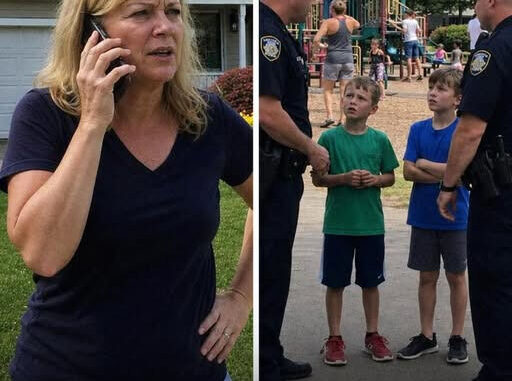
When I arrived, I saw my three boys standing near the swings. Their posture said everything before anyone spoke—confusion, fear, and uncertainty. Two police officers were nearby, speaking calmly but seriously.
One of the officers looked at me as I approached. “Are you their mother?”
“Yes,” I said quickly. “What happened?”
He explained that they had received a report about unsupervised children and concerns about possible unsafe behavior. There had even been mention of drugs, which made absolutely no sense in the context of children playing at a playground.
I felt my stomach drop.
“They’re seven and nine,” I said, trying to keep my voice steady. “They walked here from our house. I watched them leave. There are other parents around too.”
One of the officers glanced around and seemed to take in the actual scene—the playground, the other families, the normalcy of it all.
The tension eased slightly.
After a few more questions, they confirmed there was no issue. The situation was essentially a misunderstanding based on a complaint.
Before leaving, one officer offered a reminder about supervision, but it was clear even to him that the children were fine.
When they stepped away, I crouched down to my boys’ level. “You’re okay,” I told them. “You’re not in trouble.”
That’s when I noticed movement across the street.
A curtain shifted.
Someone was watching from inside a nearby house.
And I already knew, without anyone having to say it, where the call had come from.
That evening, when Mark finally came home, I told him everything. I didn’t leave out a single detail—the playground, the police, the accusations, or the way the boys had looked when they thought they were in trouble for simply playing.
When I finished, the house was quiet for a moment.
Mark’s expression tightened. “They said what?”
“That there might be drugs involved,” I said. “About our kids.”
He exhaled slowly, clearly trying to process it.
“What do you want to do?” he asked after a pause.
“I want cameras,” I said. “I want everything recorded so there’s no confusion anymore.”
He didn’t hesitate. “Alright. We’ll set them up.”
The next day, I went out and bought a small set of outdoor cameras and a doorbell camera. Nothing extreme—just enough to document what was happening around our home and give us clarity going forward.
And for the first time in a while, I felt like I had some control over the situation again.
Leave a Reply