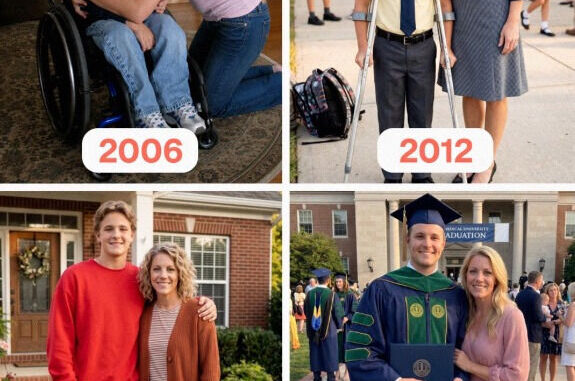
The day my husband walked out of my life, there was no dramatic slam of a door.
Strangely, that absence of sound stayed with me more than any noise ever could. My mother always used to say that when someone slams a door, it carries emotion inside it—anger, frustration, something alive and burning that still connects you, even in conflict.
“Anger can be understood, Bella,” she used to tell me. “If it has force, it still has meaning. You can work with it.”
What I got from Warren, however, wasn’t anger. It was something colder.
He glanced once at our newborn son. Then at the doctor standing near the bed. And then he simply went quiet—so completely, so sharply, it felt like something had been cut rather than said.
Henry was less than three hours old. My body still felt like it hadn’t fully recovered from giving birth. One IV line was still taped to my arm, pulling me back into reality every time I shifted. My son lay against my chest, impossibly small, one hand clenched into the fabric of my hospital gown as if holding on without even knowing why.
The neurologist spoke in a calm, measured voice—the kind of tone people use when they are trying not to alarm you, even though everything being said already changes your life.
“There are signs of motor impairment,” she explained gently. “We won’t understand the full extent right now. He will need ongoing therapy, monitoring, and developmental support over the coming months.”
I nodded as if she were explaining something routine, like medication instructions or discharge steps.
She placed a hand over mine. “This is not something you caused,” she added softly. “Pregnancies don’t always follow predictable outcomes. What matters is that this is not life-threatening. With care and support, your child can still live a full life.”
“I understand,” I whispered, though I was still absorbing every word in fragments.
Then she squeezed my hand once more. “You can reach me anytime.”
“Thank you,” I said, though my voice barely held together.
That was when Warren reached for his keys.
At first, I thought he simply needed air. He had always been someone who stepped away to process stress. I assumed he would return after a walk, calmer, more present.
I asked him quietly, “Could you hand me the water?”
He didn’t move.
Instead, he looked at Henry—not with tenderness, not with fear, but with something distant and assessing. Like he was looking at something that didn’t match the expectations he had built in his mind.
“I’m not doing this,” he said flatly.
For a moment, I couldn’t process the meaning. “Doing what?”
His jaw tightened. “I didn’t agree to a life like this, Bella. I wanted a son I could play sports with. I wanted someone I could take surfing, teach things to. That’s not going to happen here.”
I waited for him to correct himself. To soften. To realize what he was saying in front of a newborn child.
But instead, he pulled on his jacket and walked out as if he were leaving a meeting that had simply gone too long.
A nurse touched my shoulder. The doctor spoke again, but I couldn’t register the words clearly anymore.
All I could see was my son—completely unaware of the weight hanging in the room, blinking softly as if everything was still safe.
“Well,” I whispered to him, forcing a fragile smile, “it’s just you and me now, little one.”
He blinked again, as though that arrangement had always been the plan.
Two days later, I left the hospital alone.
I signed papers alone, listened to instructions about therapy and follow-up care alone, and watched other mothers leave with partners carrying flowers, bags, and balloons.
I left with my baby in my arms, a thick folder of medical documents, and a nurse named Carla walking beside me down the corridor.
“Someone coming to pick you up?” she asked gently.
“Eventually,” I said, forcing a smile that didn’t feel real.
That “eventually” became the answer I gave to everyone for a long time.
Within days, legal documents arrived. Warren’s lawyer handled everything with efficiency that felt almost mechanical. He relinquished custody, moved away to another state, and made it clear that involvement—financial or otherwise—would not be part of his life moving forward.
My apartment became a cycle of feeding bottles, washing clothes, and disinfecting surfaces that never stayed clean for long. The smell of formula mixed with baby powder and cleaning solution became constant.
I cleaned not because things were dirty, but because anxiety needed somewhere to go.
The years that followed were not heroic. They were simply exhausting.
I learned how to stretch medication schedules, how to argue with insurance companies, how to hold Henry’s legs steady while he cried through therapy sessions and I tried not to fall apart with him.
People at church began speaking to me in voices usually reserved for grief, as if I had already lost something rather than learning to live differently.
When Henry was six months old, I was in a hallway outside the nursery adjusting his braces when a woman from the choir approached.
“He’s beautiful,” she said softly, then lowered her voice. “And his father—Warren—how is he coping?”
I kept my hands steady on Henry’s clothing. “He left before I even left the hospital.”
Her expression froze in place.
Henry sneezed, breaking the tension in the air.
I kissed his forehead. “If you see the sign-in sheet, could you pass it to me? I’ve got my hands full.”
By the time Henry reached school age, he had already developed a presence that made adults uncomfortable—not because he was difficult, but because he noticed things they expected him not to.
At seven, during a school meeting, an assistant principal spoke carefully.
“We just want to be realistic,” she said. “We don’t want Henry placed in a situation where he feels frustrated by expectations he may not meet.”
Henry looked at her, then at the papers on her desk.
“Are you talking about physical ability,” he asked calmly, “or do you think I’m not smart enough?”
The woman blinked quickly. “That’s not what I meant.”
“No,” he replied, “but it is what you were implying, right?”
I pressed my lips together to keep from reacting.
In the car afterward, I couldn’t help it—I laughed.
From the back seat, Henry asked, “What’s funny?”
“You can’t talk to school staff like that,” I said.
He leaned forward. “Why not? She was wrong.”
I met his eyes in the rearview mirror. “That’s the problem. You’re often correct in a way that makes people uncomfortable.”
He considered that. “That sounds like their problem.”
I couldn’t fully argue with him.
Physical therapy became the place where frustration turned into determination.
By the time Henry was ten, he could name muscles and nerve pathways with more precision than most adults. He corrected medical students without hesitation and treated his appointments like conversations, not assessments.
One resident once tried to summarize his chart. Henry interrupted.
“I’m right here,” he said. “You can just ask me.”
The resident paused, slightly embarrassed. “Alright. How does it feel?”
“Annoying,” Henry replied. “And tight. And like everyone keeps talking about me instead of to me.”
I found myself laughing again—because he wasn’t wrong.
At fifteen, he was reading medical journals at the kitchen table while I paid bills beside him.
“What are you reading?” I asked.
“A poorly written study,” he said. “It forgets there’s a person behind the data.”
Therapy sessions became less about limitation and more about endurance. One therapist told him he was making “remarkable progress.”
Henry narrowed his eyes. “That sounds like something people say before bad news.”
The therapist smiled. “Time for stairs.”
Henry closed his eyes. “Of course it is.”
But he did it. Step by step. Carefully. Determinedly.
At sixteen, one evening, he came into the kitchen exhausted, leaning against the counter.
“I’m tired,” he said. “Of people talking about me like I’m a lesson instead of a person.”
I turned toward him. “Then what do you want to be?”
He looked at me for a long moment.
“Someone in medicine,” he said finally. “The kind of person who speaks to patients directly—not about them.”
That path became his focus. He excelled academically, eventually earning admission to medical school at the top of his class.
Then, just before graduation, something unexpected happened.
He told me his father had contacted him.
“He found me online,” Henry said one evening, sitting at the kitchen table with his tablet turned face down.
“What did he want?” I asked carefully.
“He said he was proud of me.”
The words felt unreal.
“He wants to come to graduation,” Henry added.
“No,” I said immediately.
He looked at me. “I already invited him.”
That silence between us carried more weight than anything else.
“Why?” I asked.
“Because I don’t want him telling a different version of my story,” Henry said.
Graduation night arrived with noise, lights, and families gathering everywhere.
I kept adjusting my clothes without realizing it.
Henry noticed. “You’ve done that six times,” he said quietly.
I sighed. “It’s an expensive outfit. It deserves attention.”
That made him smile.
“You look nice,” he said.
Then Warren arrived.
Time didn’t erase recognition. I knew him instantly. Slightly older, hair touched with gray, posture more controlled—but still him.
He approached as though nothing had changed.
“Bella,” he said.
“Warren.”
His attention shifted to Henry. He scanned him—his stance, his height, his stability.
“You’ve done well,” Warren said. “No wheelchair. No cane. You walk fine.”
Henry responded evenly. “Is that surprising?”
Before the conversation could continue, Henry’s name was called.
He squeezed my hand once before walking forward.
At the podium, he spoke to the audience.
“This story usually gets told a certain way,” he began. “People assume it’s about overcoming difficulty.”
He paused.
“But I’m not here because I was unusually strong. I’m here because my mother refused to leave when things got difficult.”
Silence filled the room.
“My father left the day I was born,” he said. “My mother stayed through everything after that.”
He looked directly at me.
“She never treated me like something broken. She treated me like someone worth showing up for.”
By the time he finished, the room was standing.
I never looked at Warren afterward.
Later, in the hallway, Henry found me.
“You okay?” he asked.
I let out a breath that turned into a laugh. “That was completely unnecessary.”
He smiled. “You didn’t like it?”
Before I could answer, Warren appeared.
“You invited me for that?” he asked sharply.
Henry met his gaze calmly. “I told the truth. You left when things became difficult. She stayed for everything after.”
Warren tried to respond, but Henry continued.
“You don’t get to step into the story now that it has a good ending.”
And just like that, Warren stood alone while the rest of us walked forward.
Leave a Reply