Introduction: Why Does Deli Ham Sometimes Look Iridescent?
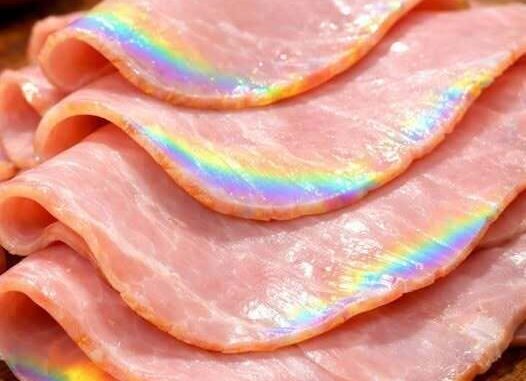
If you have ever opened a pack of sliced deli ham and noticed an unexpected shimmer of colors—greens, purples, blues, or even a silvery rainbow sheen—you are not alone. Many consumers experience this visual effect and immediately feel uncertain about what it means.
At first glance, it can look unusual or even alarming. Food is typically expected to have consistent, natural tones, so when ham appears to reflect rainbow-like colors, it may raise questions such as: Is it spoiled? Has it gone bad? Is it still safe to eat?
These concerns are understandable because visual appearance is one of the primary ways people judge whether food is fresh. However, in many situations, this colorful shine is not a warning sign at all. Instead, it is a natural optical effect caused by the physical structure of the meat and the way light interacts with its surface.
This phenomenon is known as iridescence, and it is commonly observed in processed meats under certain conditions. While it may look unusual, it is usually harmless and does not indicate spoilage on its own.
To fully understand why this happens, it is helpful to explore the science behind light reflection, the structure of meat, and how food processing contributes to the effect.
What Causes the Rainbow Shine on Ham?
The colorful appearance sometimes seen on deli ham is caused by a phenomenon called iridescence. This occurs when light is reflected in such a way that it separates into multiple visible colors, similar to how a prism splits white light into a spectrum.
Iridescence is not unique to food. It appears frequently in nature and everyday materials. Some familiar examples include:
- Soap bubbles floating in sunlight
- Thin layers of oil spreading over water
- The shimmering feathers of a peacock
- The wings of certain butterflies
- The reflective surface of CDs or DVDs
- Certain naturally layered minerals and crystals
In all of these cases, the colors are not actually “painted” or present as pigments. Instead, they are produced by light interacting with microscopic structures that alter how it is reflected back to the eye.
The same principle applies to slices of ham.
The Role of Meat Structure in Light Reflection
To understand why deli ham can show rainbow-like colors, it is important to consider what meat is made of at a microscopic level.
Ham consists primarily of muscle fibers, water content, and naturally occurring proteins and fats. These components are organized in extremely fine structures that are not visible to the naked eye.
When ham is sliced—especially in commercial food production settings—the cutting process creates very smooth surfaces. These smooth surfaces are key to the iridescent effect.
When light hits such a surface, it does not simply bounce back uniformly. Instead, it interacts with:
- The alignment of muscle fibers
- Moisture trapped between structures
- Protein layers within the meat
- Tiny surface variations created during slicing
Because these structures are so fine, they can influence how different wavelengths of light reflect. As a result, certain colors become more visible depending on the viewing angle.
This is similar to how a prism works: white light enters, and different wavelengths are separated, making individual colors visible.
So, the rainbow sheen is not something “added” to the ham—it is a visual effect created by physics.
Why Deli Ham Shows Iridescence More Often Than Other Meats
Although iridescence can occur in many types of meat, it is especially common in processed and cured products such as deli ham. Several factors make these products more likely to display the effect.
1. Extremely Smooth Cutting Surfaces
Commercial slicers are designed to produce uniform, thin slices with very smooth surfaces. The smoother the surface, the more evenly light can reflect, which increases the likelihood of visible color separation.
In contrast, hand-cut or rougher meat surfaces scatter light more randomly, reducing the effect.
2. Higher Moisture Content
Processed ham often contains retained moisture from curing and cooking methods. Water on or within the surface of the meat can act as a medium that enhances light reflection and refraction.
This moisture can make the rainbow effect more noticeable, especially under bright or direct lighting.
3. Muscle Fiber Arrangement
The natural structure of muscle tissue in ham can influence how light behaves when it strikes the surface. Certain alignments of fibers create conditions that support subtle optical interference patterns.
4. Effects of Curing and Processing
Curing involves treating meat with salt, water, and sometimes preservatives to improve flavor and shelf life. These processes can slightly alter the texture and density of the meat, making optical effects more visible under certain conditions.
None of these factors indicate a problem with the food. Instead, they are normal consequences of how deli meats are produced.
Does a Rainbow Shine Mean the Ham Is Unsafe?
In most cases, the answer is no. A rainbow-colored sheen on ham is not considered a reliable indicator of spoilage or contamination.
Food safety experts generally agree that iridescence alone should not be used to judge whether meat is safe to consume. Instead, spoilage is identified through a combination of sensory and storage-related factors.
These include:
- Expiration or “use by” date
- How the product has been stored
- Smell or odor changes
- Texture changes
- Packaging condition
- Visible signs of mold or contamination
If the ham has been kept properly refrigerated, remains within its expiration date, and shows no other signs of deterioration, the presence of rainbow-like colors is typically harmless.
Understanding the Difference Between Iridescence and Spoilage
It is important to distinguish between natural optical effects and genuine food spoilage because they can sometimes be confused.
Iridescence (Harmless Optical Effect)
- Appears as shifting rainbow colors
- Changes depending on viewing angle
- Often visible under bright or direct light
- Disappears or changes when the meat is moved
- Caused by light reflection, not biological decay
Signs of Spoiled Ham
- Strong, unpleasant or sour smell
- Sticky or overly slimy texture
- Dark or grayish discoloration unrelated to lighting
- Visible mold growth
- Damaged or bloated packaging
- Off taste (if already consumed)
The key difference is that iridescence is purely visual and dependent on lighting, while spoilage involves physical and sensory changes in the food itself.
How Light Produces the Rainbow Effect
To better understand this phenomenon, it helps to look at how light behaves.
White light is actually made up of multiple colors combined together. When this light hits a surface, several things can happen:
- It can be absorbed
- It can reflect directly
- It can scatter in different directions
- It can interfere with itself as waves overlap
In the case of deli ham, the microscopic surface structure causes light waves to reflect at slightly different angles. Because each color wavelength behaves slightly differently, the separation becomes visible to the human eye.
This is why:
- The colors may shift when you tilt the ham
- The effect may disappear under different lighting
- Certain angles show stronger rainbow patterns than others
Even small changes in light direction can dramatically alter how the surface appears.
Similar Optical Effects in Other Foods
Ham is not the only food that can show iridescence. Consumers may also notice similar effects in:
- Roast beef
- Turkey slices
- Bacon
- Cooked chicken or poultry
- Certain fish products
In each case, the explanation is largely the same: light interacting with smooth, protein-based surfaces and structured muscle fibers.
Because many processed meats share similar production methods, they can all occasionally display this visual phenomenon.
The Influence of Modern Food Processing
Modern meat production focuses on consistency, safety, and long shelf life. To achieve this, manufacturers carefully control multiple factors during processing, including:
- Temperature during cooking and cooling
- Moisture retention levels
- Slicing precision
- Packaging methods
- Storage conditions before distribution
These tightly controlled processes improve food quality and safety, but they can also unintentionally make optical effects like iridescence more visible.
For example, vacuum-sealed packaging can preserve surface moisture, while machine slicing creates smoother textures. Together, these factors can enhance the conditions needed for rainbow-like reflections.
It is important to note that these effects are visual only and do not reflect a change in nutritional value or safety when proper handling guidelines are followed.
Why People Often Worry When They See It
Human perception is strongly influenced by visual cues. When something looks unusual, the brain naturally interprets it as a potential warning.
Food safety concerns are often triggered by:
- Unexpected colors
- Changes in texture
- Unfamiliar visual patterns
Because many people associate color changes in food with spoilage, it is understandable that iridescent ham may raise concern.
However, not all color variations indicate deterioration. In this case, the effect is purely structural and optical rather than chemical or biological.
Education about these differences helps reduce unnecessary food waste and prevents confusion.
What Food Safety Experts Generally Recommend
Food safety professionals typically advise evaluating meat using a combination of indicators rather than relying on appearance alone.
When checking deli ham or similar products, consider the following:
1. Storage Temperature
Meat should be kept refrigerated at appropriate temperatures. If it has been left at room temperature for extended periods, it may no longer be safe, regardless of appearance.
2. Expiration Date
Always check the “use by” or “best before” date. While these dates are not absolute guarantees, they provide important safety guidance.
3. Smell
Fresh deli meat usually has a mild or neutral smell. A sour, rancid, or strongly unpleasant odor is a clear warning sign.
4. Texture
Ham should feel moist but not sticky or excessively slimy. Any drastic texture change may indicate spoilage.
5. Packaging Condition
If packaging is swollen, leaking, or damaged, the product should be treated with caution.
6. Visual Appearance Beyond Iridescence
Look for mold growth, unusual dark spots, or discoloration that does not change with lighting.
By combining these factors, consumers can make more accurate judgments about food safety.
Final Thoughts
A rainbow-like shimmer on deli ham can look unusual, but in most cases, it is simply a result of how light interacts with the microscopic structure of the meat. This phenomenon, known as iridescence, is a natural optical effect and is not typically a sign of spoilage.
Understanding the science behind it helps remove unnecessary concern and reduces the likelihood of throwing away perfectly safe food. While it is always important to follow proper food safety guidelines, appearance alone—especially when it comes to rainbow reflections—should not be the sole deciding factor.
By paying attention to storage conditions, smell, texture, and expiration dates, consumers can confidently determine whether deli meats are safe to eat, even when they display unexpected colors.
Leave a Reply